
Attraction
Grand-Place
Brussels' central market square, rebuilt after the 1695 bombardment, framed by the Gothic Town Hall and ornate guildhalls and listed by UNESCO in 1998.
There are plenty of things to do in Brussels, and the Belgian capital rewards visitors who look beyond its reputation as a city of institutions. The historic centre is compact, built around the Grand-Place with its Gothic Town Hall and guildhalls, the Royal Galleries of Saint-Hubert and the Manneken Pis. Uphill, the Royal Quarter and the Mont des Arts hold the Royal Museums of Fine Arts, the Magritte Museum and the Musical Instruments Museum, while the European Quarter, the Parc du Cinquantenaire, the Art Nouveau streets of Saint-Gilles and Ixelles and the Atomium in the north add very different sides to the city.
Food and drink are a big part of any stay. Brussels is the home of moules-frites, waffles, speculoos and some of the world's best-known chocolatiers, and its cafés pour gueuze and lambic beers that are brewed nowhere else, alongside a fine-dining scene with several Michelin-starred tables. Two or three days covers the main sights, museums and neighbourhoods, while four or five days leaves time for markets, comics murals, a jazz evening and a day trip to Bruges, Ghent or Antwerp.
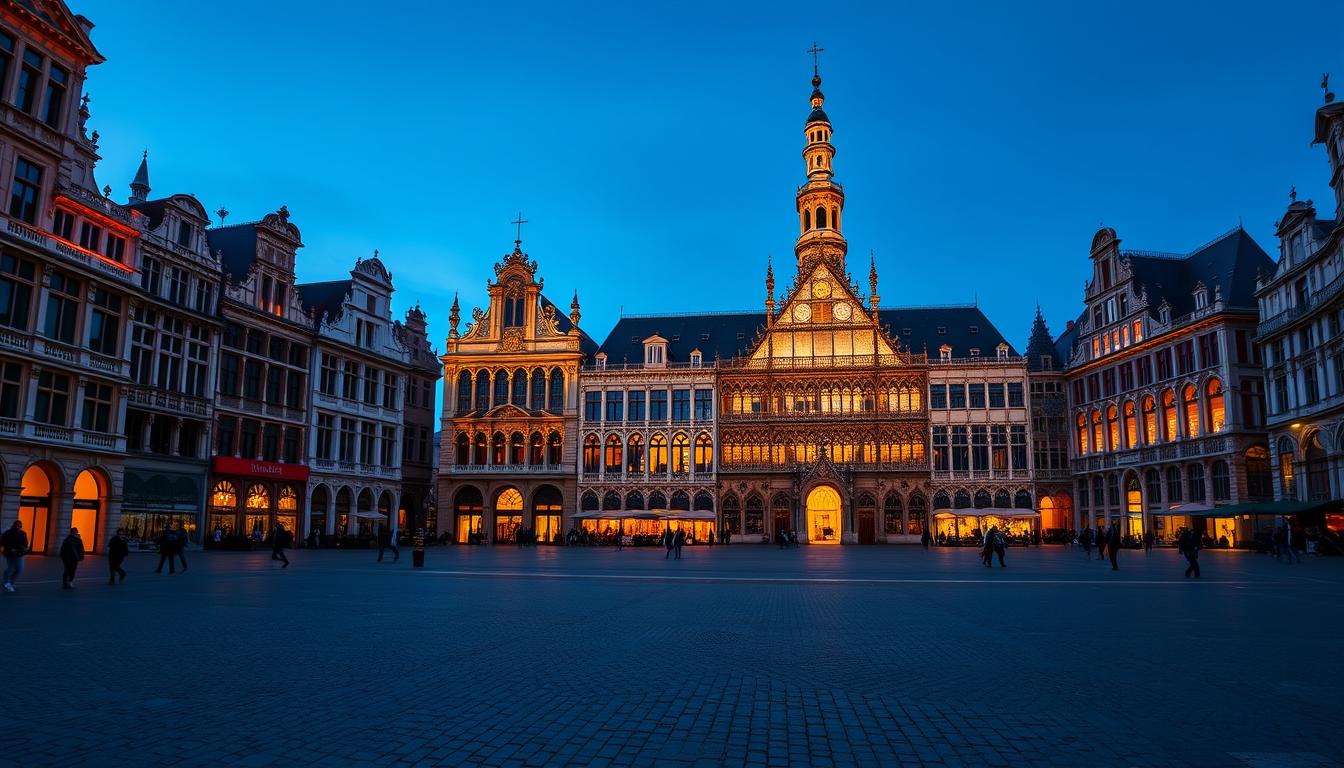
Attraction
Brussels' central market square, rebuilt after the 1695 bombardment, framed by the Gothic Town Hall and ornate guildhalls and listed by UNESCO in 1998.
Attraction
Brussels' small bronze fountain of a urinating boy, first cast in the 17th century, famous for its wardrobe of around 1,000 costumes.
Attraction
A 102-metre model of an iron crystal built for Expo 58 on the Heysel plateau, with exhibitions, a panoramic top sphere and a restaurant.
Attraction
Belgium's leading art collection, founded in 1801, with more than 20,000 works across the Old Masters, Magritte and Fin-de-Siècle museums.
Attraction
A collection of more than 7,000 instruments in the Old England building, an Art Nouveau department store designed by Paul Saintenoy in 1899.
Attraction
Brussels' Brabantine Gothic cathedral, built between the 13th and early 16th centuries, with twin 69-metre towers, Renaissance stained glass and a Baroque pulpit.
Café
A long-standing café-brasserie inside the Royal Galleries of Saint-Hubert, known for its gallery terrace and crisp Brussels waffles with chocolate sauce.
Café
The oldest biscuit maker in Brussels, founded in 1829 by Jean-Baptiste Dandoy, famous for its speculoos and also known for waffles near the Grand-Place.
Café
A Brussels pâtisserie and chocolate house on the Place du Grand Sablon since 1910, known for its cakes, chocolates and viennoiseries.
Café
A chocolatier's shop and tea room near the Mont des Arts, serving 70 per cent hot chocolate, coffee with ganache, ice cream and handmade chocolates.
Café
The Brussels café of a Belgian micro-roastery founded in 2012, serving seasonal specialty coffee, home-baked pastries and vegetarian breakfast and lunch.
Café
A small coffee house in the Royal Galleries of Saint-Hubert serving certified-organic coffee from Ethiopia, along with baobab drinks, herbal teas and Ethiopian beer.
Hotel
A five-star Rocco Forte hotel between the Grand-Place and the Manneken Pis, with an Italian restaurant, the jazz-filled Bar Magritte and family suites.
Hotel
The Belle Époque Grand Hotel Astoria of 1910, restored and reopened by Corinthia in December 2024 with 126 rooms, a 1,200 m² spa and chef-led restaurants.
Hotel
The grand dame of Avenue Louise, opened in 1913 and since renovated, with 225 rooms, a spa with an infinity pool and the open-air La Terrasse.
Hotel
A 150-room design hotel on the site of a former abbey, incorporating the façade of the house where painter Jacques-Louis David lived.
Hotel
A characterful four-star boutique hotel behind a discreet façade between the Grand-Place and Brussels-Central, spread across a historic house and garden wing.
Hotel
A 23-room boutique hotel beneath the glass roof of the Royal Galleries of Saint-Hubert, with parquet floors, wooden shutters and Belgian designer furniture.
Bar
The original bar of the Delirium Village near the Grand-Place, famous for a Guinness World Record for the size of its beer list.
Bar
One of the oldest cafés in Brussels, opposite the Royal Galleries of Saint-Hubert, once frequented by Jacques Brel and known for its gueuze.
Bar
An Art Deco cocktail bar founded in 1937 near the Bourse, open late every night, with jazz concerts on weekend afternoons.
Bar
A protected heritage café where René Magritte and the surrealists drank before the war and CoBrA artists met after it, open daily for Brussels beer.
Bar
The original city-centre taproom and brewery of the Brussels Beer Project, offering its own craft beers, tastings and brewery tours on Rue Antoine Dansaert.
Bar
Brussels' best-known techno club, opened in the Marolles in 1994 and long ranked among DJ Mag's top 100 clubs in the world.
Restaurant
A family-run Brussels institution since 1926, holding one Michelin star, known for its Horta-style Art Nouveau dining room and classic sauces.
Restaurant
Chef Karen Torosyan's two-Michelin-star restaurant inside Horta's Centre for Fine Arts, celebrated for its pâté en croûte and pastry dishes.
Restaurant
A long-established Brussels fine-dining address, now led by Yves Mattagne and holding one Michelin star, mixing shared plates with classic tableside cooking.
Restaurant
A one-Michelin-star Japanese counter restaurant in Ixelles where chef Kamo serves made-to-order sushi at lunch and surprise tasting menus at dinner.
Restaurant
A classic Belgian brasserie on the Rue des Bouchers since 1921, serving mussels, Flemish carbonnade and seafood waterzooi in historic dining rooms.
Restaurant
An Art Nouveau brasserie on the Place de la Chapelle where a Brussels-born chef cooks traditional dishes such as veal cheeks in Cantillon beer.
Thing to do
A 213-metre glass-roofed arcade opened in 1847, one of Europe's earliest covered shopping galleries, lined with chocolatiers, cafés, a theatre and a cinema.
Thing to do
A terraced formal garden between the lower and upper town, created between 1956 and 1969, with one of the best free views over central Brussels.
Thing to do
A daily flea market held on the Place du Jeu de Balle in the Marolles since 1873, selling antiques, curios, books and bric-a-brac.
Thing to do
A self-guided trail of more than 50 large comic-strip murals painted on walls across central Brussels since 1991, featuring Tintin, Lucky Luke and more.
Thing to do
An elegant upper-town district of antique dealers and chocolatiers around the Grand Sablon square, its Gothic church and the Petit Sablon garden.
Tour operator
A Brussels cycling association running themed three-hour guided bike tours of the city from March to December, with classic and electric bikes to rent.
Tour operator
A Brussels urban action association whose guided tours explore the city's architecture and heritage, including a summer tour of Art Nouveau around Avenue Louise.
Tour operator
A Brussels non-profit that has run guided walks, interior visits and exhibition tours on the city's architecture, heritage and art for more than 30 years.
Tour operator
A Brussels organisation promoting boat trips on the city's canal and waterways, with guided cruises from May to October and a Waterbus service to Vilvoorde.
Tour operator
A family lambic brewery founded in 1900 in Anderlecht, where visitors can tour the working brewery and Gueuze Museum and see how spontaneously fermented lambic is…
Two to three days covers the Grand-Place, the main museums, the Atomium and a few neighbourhoods; add a day or two for day trips to Bruges, Ghent or Antwerp.
The old centre around the Grand-Place is best for first-time visitors; the Sablon and the Royal Quarter are quieter and more elegant, Dansaert and Sainte-Catherine suit those who want bars and restaurants, and Ixelles and the area around Avenue Louise offer a more residential feel.
From Brussels Airport, frequent trains run to Brussels-Nord, Brussels-Central and Brussels-Midi in around 20 minutes; from Charleroi Airport, shuttle buses run to Brussels-Midi.
Brussels is moderately priced for a Western European capital; hotels can be cheaper at weekends, when business travel is lower, and friteries, markets and free sights help keep costs down.
Brussels is generally safe for visitors, but pickpockets operate in crowded areas such as the Grand-Place, major stations and the metro, so keep valuables secure and stay aware late at night around the large stations.