
!DISCLOSURE
Prague is one of the most beautiful cities in Europe and one of the easiest to reach from the UK. Direct flights take under two hours, the historic centre is compact enough to explore on foot, and the city’s Gothic towers, Baroque churches and cobbled lanes survived the twentieth century remarkably intact. Add good value food, world famous beer and lively nightlife, and it is no surprise that Prague is one of the most popular weekend breaks for British travellers.
This guide covers the 25 best things to do in Prague, grouped by area so you can plan your days without doubling back. For each one you will find what it is, why it is worth your time, how long to allow, what it costs in 2026 and the best time to go. You will also find a three day itinerary, the best day trips, money saving tips, how much beer really costs and answers to the questions people ask most. Prices were checked in November 2026 and can change, so confirm on official websites before you travel.
Things to do in Prague at a glance
| Area | Top things to do | Time needed |
|---|---|---|
| Old Town | Old Town Square, Astronomical Clock, Týn Church, Old Town Hall Tower | Half a day |
| Jewish Quarter | Synagogues, Old Jewish Cemetery, Spanish Synagogue | Half a day |
| Charles Bridge and Malá Strana | Charles Bridge, St Nicholas Church, Lennon Wall, Kampa Island | Half a day |
| Prague Castle and Hradčany | Castle, St Vitus Cathedral, Golden Lane, Strahov Monastery | A full day |
| New Town | Wenceslas Square, National Museum, Dancing House | Half a day |
| Beyond the centre | Vyšehrad, Petřín Hill, Letná beer garden | Half a day each |
How to plan your time in Prague
Prague’s main sights sit on two sides of the Vltava river. The Old Town, the Jewish Quarter and the New Town are on the east bank. Charles Bridge crosses to Malá Strana, the Lesser Town, with Prague Castle on the hill above. A good plan is one day for the Old Town and Jewish Quarter, one day for the castle and Malá Strana, and one day for Vyšehrad, Petřín or a day trip.
The castle and Charles Bridge are busiest from late morning to late afternoon. Start early, or visit Charles Bridge at sunrise and the castle grounds in the evening, when the crowds have gone.
The Old Town
1. Old Town Square
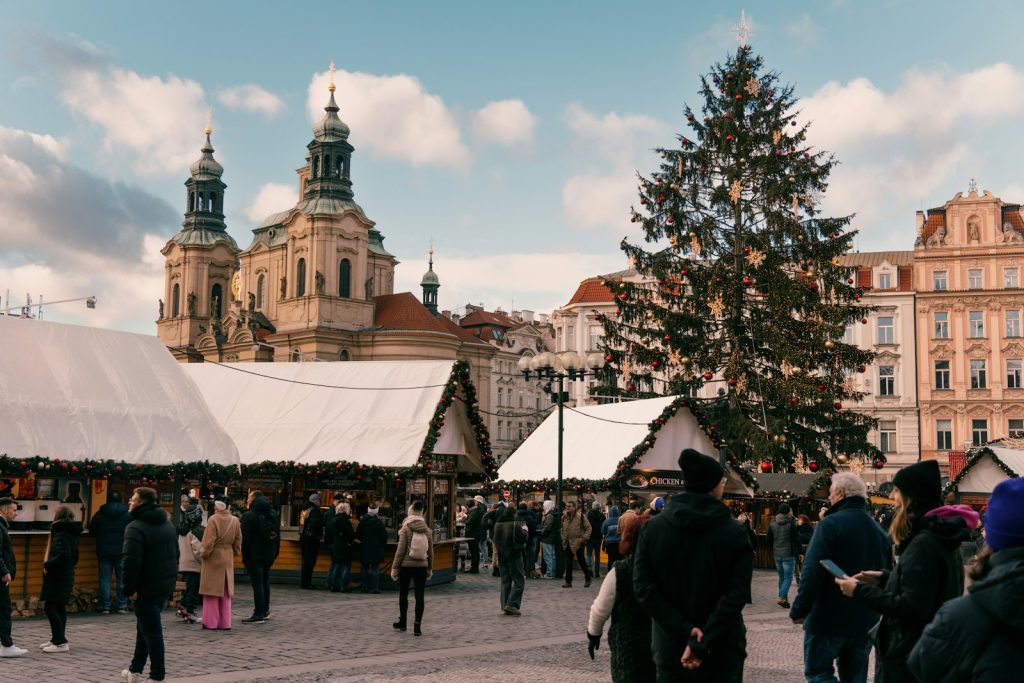
Old Town Square, or Staroměstské náměstí, is the heart of Prague. It is surrounded by pastel coloured houses, Baroque churches and the twin Gothic spires of the Týn Church, with the Jan Hus Memorial in the middle. It is busy at all hours, but it is beautiful at any time, and especially at Christmas, when the market runs from 28 November 2026 to 6 January 2027.
2. The Astronomical Clock
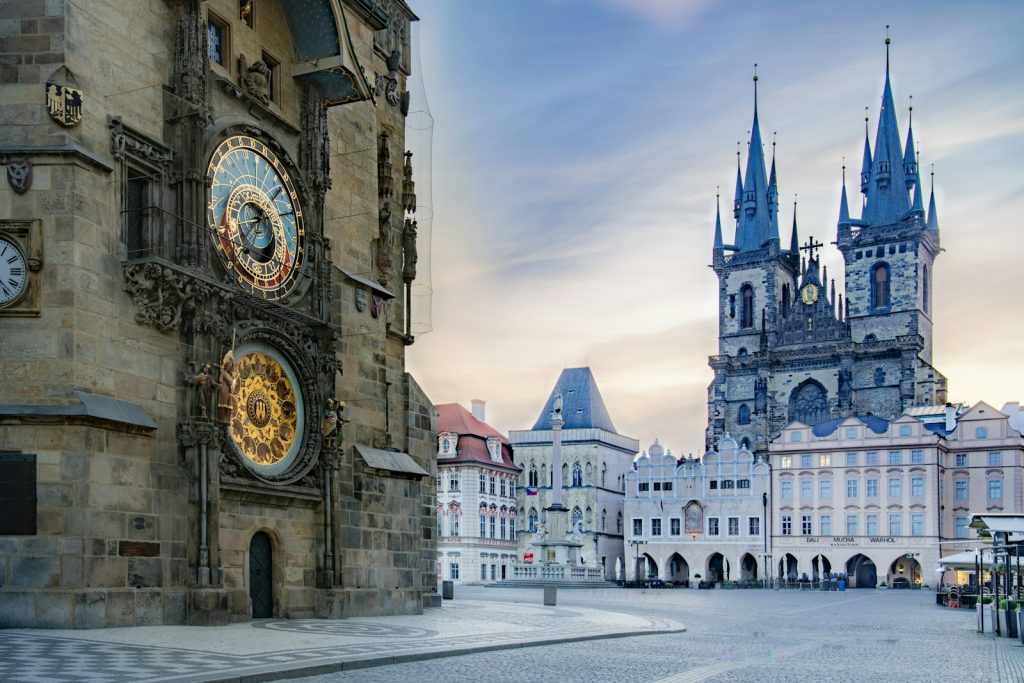
Installed in 1410, the Astronomical Clock on the side of the Old Town Hall is the oldest working clock of its kind in the world. On the hour, from morning to late evening, the figures of the Apostles parade past two little windows while a skeleton rings a bell. The show lasts less than a minute and the crowd is big, so arrive a few minutes early or watch from one of the cafés across the square.
3. Old Town Hall Tower
For one of the best views in Prague, climb, or take the lift, to the top of the Old Town Hall Tower. The gallery looks straight down onto the square and across to the Týn Church and Prague Castle. Your ticket also lets you see the inside of the clock mechanism and the Gothic halls and cellars beneath the Town Hall. Go at sunset for the best light.
4. Týn Church
The Church of Our Lady before Týn, with its two dark spires, dominates the square and is one of the symbols of Prague. Its entrance is tucked away behind a row of houses. Inside, the Gothic and Baroque interior holds the tomb of the Danish astronomer Tycho Brahe. Opening hours are limited, so check before you go.
5. The Powder Tower and the Municipal House
At the edge of the Old Town, the Gothic Powder Tower once marked one of the city’s gates. Next to it, the Municipal House, or Obecní dům, is a masterpiece of Art Nouveau, with a grand café, a French restaurant and the Smetana Hall, one of Prague’s main concert venues. Join a guided tour of the interior or simply have coffee under the chandeliers.
6. The Klementinum
The Klementinum, a vast former Jesuit college near Charles Bridge, is home to one of the most beautiful Baroque libraries in Europe and an astronomical tower with a fine view over the rooftops. Visits are by guided tour only, and you look into the library from the doorway rather than walking through it.
The Jewish Quarter
7. Josefov and the Jewish Museum
Josefov, the old Jewish Quarter, is one of the best preserved Jewish historical sites in Europe. The Jewish Museum in Prague runs a single ticket covering several synagogues and the Old Jewish Cemetery, where more than 12,000 gravestones lean against each other under the trees. Highlights include the Pinkas Synagogue, whose walls are inscribed with the names of almost 80,000 Czech and Moravian Jews murdered in the Holocaust, and the richly decorated Spanish Synagogue.
The Old New Synagogue, the oldest active synagogue in Europe, needs a separate ticket. Most sites close on Saturdays and Jewish holidays. Allow half a day.
Charles Bridge and Malá Strana
8. Charles Bridge
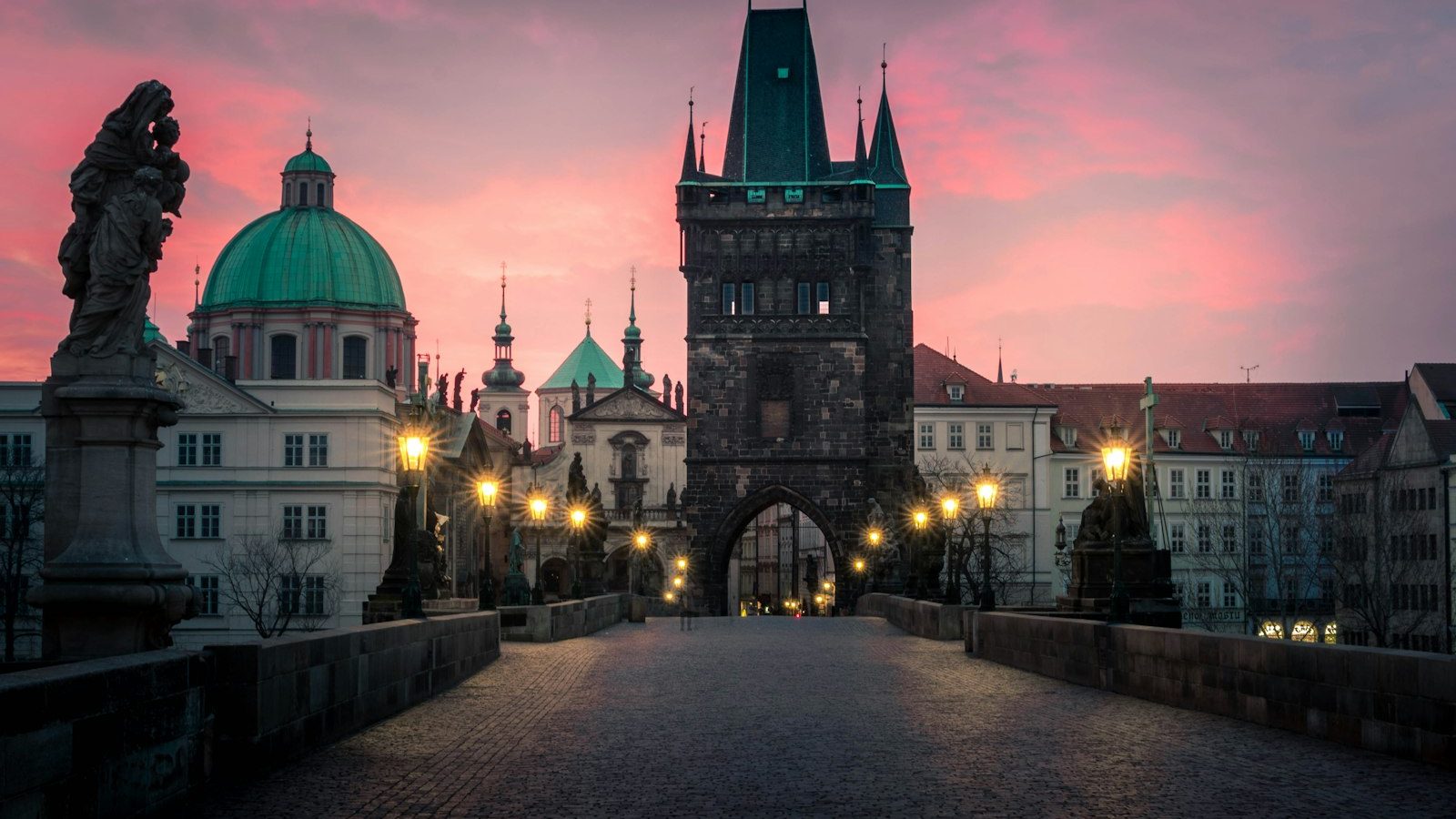
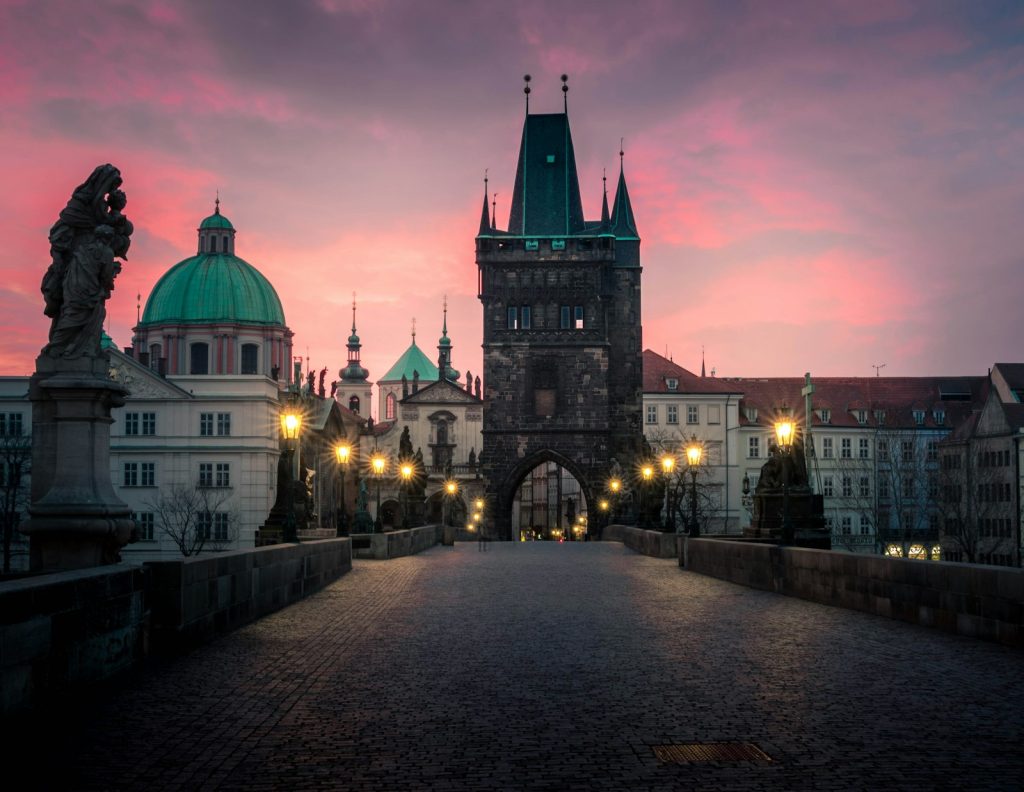
Charles Bridge, begun in 1357, links the Old Town with Malá Strana and is lined with 30 Baroque statues of saints. During the day it fills with artists, musicians and tourists. To see it at its best, go at sunrise, when you may have it almost to yourself, or after dark when the castle is lit up above you.
Touch the plaque of St John of Nepomuk, about halfway across, for good luck. You can also climb the Gothic towers at either end for a view along the bridge.
9. Malá Strana
Malá Strana, the Lesser Town, is a lovely tangle of Baroque palaces, gardens and cobbled streets between the river and the castle. The green dome of St Nicholas Church rises over the main square, and its interior is one of the finest Baroque spaces in central Europe. Climb the bell tower for a close up view of the castle.
10. The Lennon Wall and Kampa Island
After John Lennon’s death in 1980, young Czechs began painting his image and Beatles lyrics on this wall in Malá Strana as a protest against the communist regime. It is still covered in colourful graffiti today. A few steps away, Kampa Island is a peaceful park by the river with views of Charles Bridge and quirky sculptures by David Černý, including giant crawling babies.
11. Wallenstein Garden
Behind a high wall in Malá Strana, the Wallenstein Garden is a formal Baroque garden with fountains, statues, an artificial cave wall and peacocks. It is free and usually open from spring to autumn, and it is a perfect quiet break between sights.
12. A river cruise on the Vltava
A boat trip on the Vltava is a relaxing way to see the city from the water, with views of Charles Bridge, the castle and the Old Town embankment. Choose a short sightseeing cruise, a dinner cruise or a trip through the small canal of Čertovka, the Devil’s Stream, in Malá Strana.
Prague Castle and Hradčany
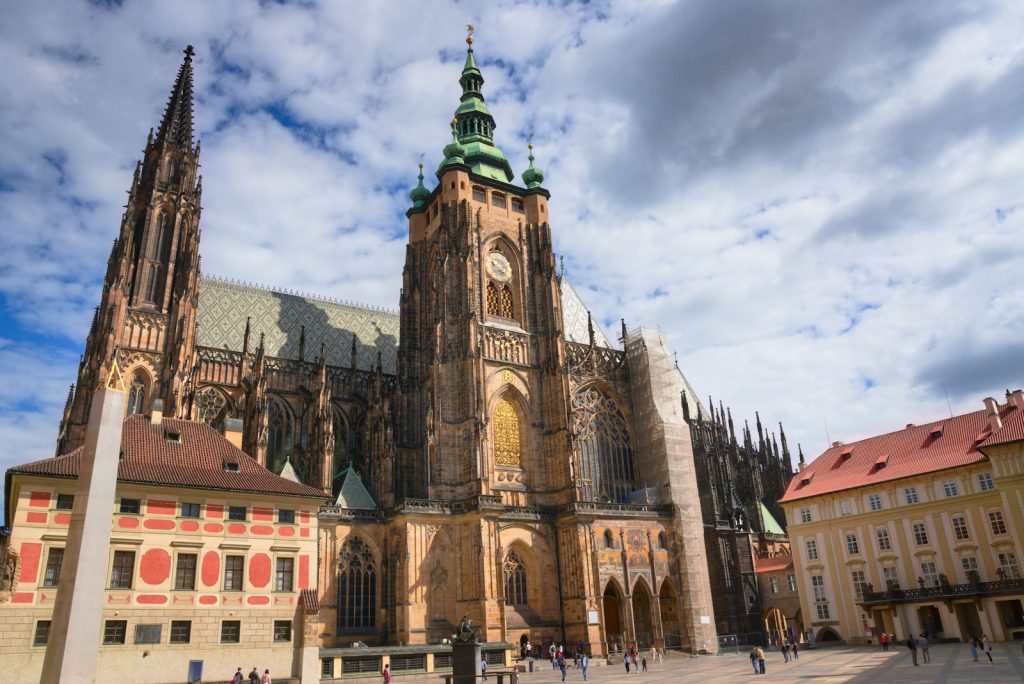
13. Prague Castle
Prague Castle is one of the largest ancient castle complexes in the world, a mix of palaces, churches, courtyards and gardens that has been the seat of Czech rulers for more than a thousand years. The courtyards and grounds are free to enter.
To see inside the main buildings, buy the main circuit ticket, which in 2026 costs 450 Czech koruna for adults, 300 koruna reduced and 950 koruna for a family. It covers St Vitus Cathedral, the Old Royal Palace, St George’s Basilica and Golden Lane with Daliborka Tower. Climbing the cathedral’s tower is a separate ticket. Allow at least three hours.
Watch the changing of the guard at the main gate on the hour, with a larger ceremony at midday.
14. St Vitus Cathedral
The Gothic St Vitus Cathedral, at the heart of the castle, took almost 600 years to complete. Inside are brilliant stained glass windows, including one designed by Alfons Mucha, the silver tomb of St John of Nepomuk and the chapel of St Wenceslas, decorated with gemstones. Arrive when the castle opens to beat the queue.
15. Golden Lane
Golden Lane is a row of tiny, brightly painted houses built into the castle walls, once home to castle guards and craftsmen. Franz Kafka lived and wrote at number 22 for a short time. Today the houses are set up as small museums and shops.
16. Strahov Monastery
Up the hill from the castle, Strahov Monastery has two stunning Baroque libraries, the Theological Hall and the Philosophical Hall, which you view from the doorways. The monastery also runs a brewery and restaurant, a perfect stop for lunch. From the gardens nearby, the view over Prague is one of the best in the city.
The New Town
17. Wenceslas Square and the National Museum
Wenceslas Square is a long boulevard rather than a square, lined with hotels, shops and Art Nouveau buildings. It has been the stage for some of the biggest moments in Czech history, including the protests of the Velvet Revolution in 1989. At the top, the grand National Museum has natural history and history collections and a beautiful domed Pantheon.
18. The Dancing House
The Dancing House, designed by Frank Gehry and Vlado Milunić and completed in 1996, is a curving glass and concrete building on the river, nicknamed Fred and Ginger. There is a gallery inside and a rooftop bar with views up the Vltava to the castle.
19. Kafka’s rotating head
Behind the Quadrio shopping centre, David Černý’s huge metal sculpture of Franz Kafka’s head is made of 42 moving panels that turn and realign to form his face. It is free to watch and fun to film.
Beyond the centre
20. Vyšehrad
Vyšehrad is a fortress on a rock above the Vltava, said to be the site of the city’s legendary founding. It is quieter than the castle, with walls you can walk along, the twin spired Basilica of St Peter and St Paul and a cemetery where the composers Dvořák and Smetana are buried. The views at sunset are wonderful.
21. Petřín Hill
Petřín Hill rises above Malá Strana, with orchards, gardens, a mirror maze and the Petřín Lookout Tower, a small copy of the Eiffel Tower. You can walk up through the park, or take the funicular when it is running. The tower gives a huge view over the whole city.
22. Letná Park and its beer garden
Across the river from the Old Town, Letná Park has one of the most famous beer gardens in Prague, with long tables under the chestnut trees and a sweeping view of the bridges and the Old Town. It is at its best on a warm summer evening.
23. Drink Czech beer
The Czech Republic drinks more beer per person than any other country, and Prague is a great place to try it. Visit a historic pub such as U Fleků, which has brewed its own dark lager for centuries, or U Zlatého tygra, a favourite of locals. A beer tasting tour is a fun way to learn the difference between styles.
24. Black light theatre and classical concerts
Black light theatre, where performers in black move glowing props against a dark stage, is a Prague speciality. The city also has excellent opera and classical music, from the National Theatre and the Rudolfinum to smaller concerts in churches all over the Old Town.
25. Day trips from Prague
- **Kutná Hora:** about an hour by train, famous for the Sedlec Ossuary, decorated with the bones of thousands of people, and the Gothic St Barbara’s Cathedral.
- **Karlštejn Castle:** a fairytale Gothic castle about 40 minutes by train.
- **Český Krumlov:** a beautiful medieval town around three hours away, best visited on a tour or with an overnight stay.
- **Terezín:** the former ghetto and concentration camp, about an hour away, a sobering but important visit.
A three day Prague itinerary
| Day | Morning | Afternoon | Evening |
|---|---|---|---|
| Day 1 | Old Town Square, Astronomical Clock, Týn Church | Jewish Quarter and synagogues, Old Town Hall Tower | Dinner in the Old Town and a classical concert |
| Day 2 | Charles Bridge at sunrise, Prague Castle and St Vitus | Golden Lane, Strahov Monastery, Malá Strana, Lennon Wall | River cruise or Letná beer garden |
| Day 3 | Vyšehrad or a day trip to Kutná Hora | Wenceslas Square, National Museum, Dancing House | Black light theatre or a beer tasting |
Getting there and getting around
- **Flights from the UK:** direct flights to Václav Havel Airport take about one hour 50 minutes from London, with routes from many UK airports.
- **From the airport:** the Airport Express bus runs to the main station, and city buses connect with the metro. A taxi or ride hailing car takes about 30 minutes to the centre.
- **On foot:** the centre is very walkable, though the climb to the castle is steep. Take tram 22 up to the castle and walk down.
- **Public transport:** a single network of metro, trams and buses. Buy tickets before you board in the PID Lítačka app or at machines, and validate paper tickets when you board.
How much does Prague cost?
The Czech Republic uses the koruna, not the euro. Prices on Old Town Square and around Charles Bridge are much higher than elsewhere.
| Item | Typical price in 2026 |
|---|---|
| Half litre of beer in a local pub | about 60 to 90 koruna, roughly £2 to £3 |
| Coffee | about 70 to 100 koruna |
| Traditional main course | about 250 to 400 koruna |
| Prague Castle main circuit | 450 koruna |
| Return flight from the UK | from about £50 to £200, depending on dates and airport |
| Central hotel, per night | from about £70 for a simple room to £200 for a boutique hotel |
Where to stay in Prague
- **Old Town:** the most central choice for a first visit, close to everything, but busy and more expensive.
- **Malá Strana:** romantic and quieter at night, close to the castle and Charles Bridge.
- **New Town:** good value, well connected and close to Wenceslas Square.
- **Vinohrady:** a leafy residential area with great cafés and restaurants, a short tram ride from the centre.
Practical tips for Prague
- **Change money carefully:** avoid street exchange booths that advertise zero commission, as the rates can be terrible. Pay by card or use a bank ATM, and always choose to be charged in koruna.
- **Check your bill:** some restaurants in tourist areas add charges for bread or a cover charge. Read the menu and the bill.
- **Use official taxis or apps** rather than hailing cars on Wenceslas Square or at the station.
- **Validate tickets:** paper public transport tickets must be stamped when you board, and inspectors issue fines on the spot.
- **Stay connected:** an eSIM gives you data for maps and transport apps without roaming charges.
Frequently asked questions
What are some things to do in Prague this week?
In late November and December, the highlights are the Christmas markets on Old Town Square and Wenceslas Square and the Christmas Stroll at Prague Castle, which runs from 28 November 2026 to 3 January 2027. At any time of year, check the programmes at the National Theatre, the Rudolfinum and the Municipal House for concerts and opera.
How much is a beer in Prague?
In an ordinary pub away from the main squares, a half litre of Czech beer typically costs about 60 to 90 koruna, roughly £2 to £3. Expect to pay much more on Old Town Square or in bars aimed at tourists.
Was Harry Potter filmed in Prague?
No. The Harry Potter films were mainly shot in the UK. Prague has, however, been used for many other films, including Mission: Impossible and Casino Royale, and its old streets often stand in for other European cities.
Is Prague a walkable city?
Yes. Most of the main sights are within a 30 minute walk of each other, and the centre is best explored on foot. The only steep part is the climb to Prague Castle, which you can avoid by taking tram 22 up and walking down.
What are the do’s and don’ts in Prague?
Do visit the big sights early, try the local beer and food, use public transport and pay by card. Don’t change money at zero commission booths, don’t take unofficial taxis, don’t eat on Old Town Square if you are on a budget, and don’t forget to validate your tram ticket.
Is 3 days in Prague too long?
No. Three days is ideal. It gives you time for the Old Town and Jewish Quarter, the castle and Malá Strana, and either Vyšehrad and Petřín or a day trip. With four or five days, you can add Kutná Hora and Český Krumlov.
When is the best time to visit Prague?
April to June and September to October bring mild weather and fewer crowds than July and August. December is magical for the Christmas markets but cold, and January and February are the cheapest months.
Plan the rest of your trip
Prague’s Christmas market is one of the best in Europe, so see our guide to the best Christmas markets in Europe for 2026 dates. If you are planning more city breaks, read our guides to the best things to do in Krakow and the best things to do in Lisbon, or browse our Europe travel guides. If you spot something out of date, please let us know.