
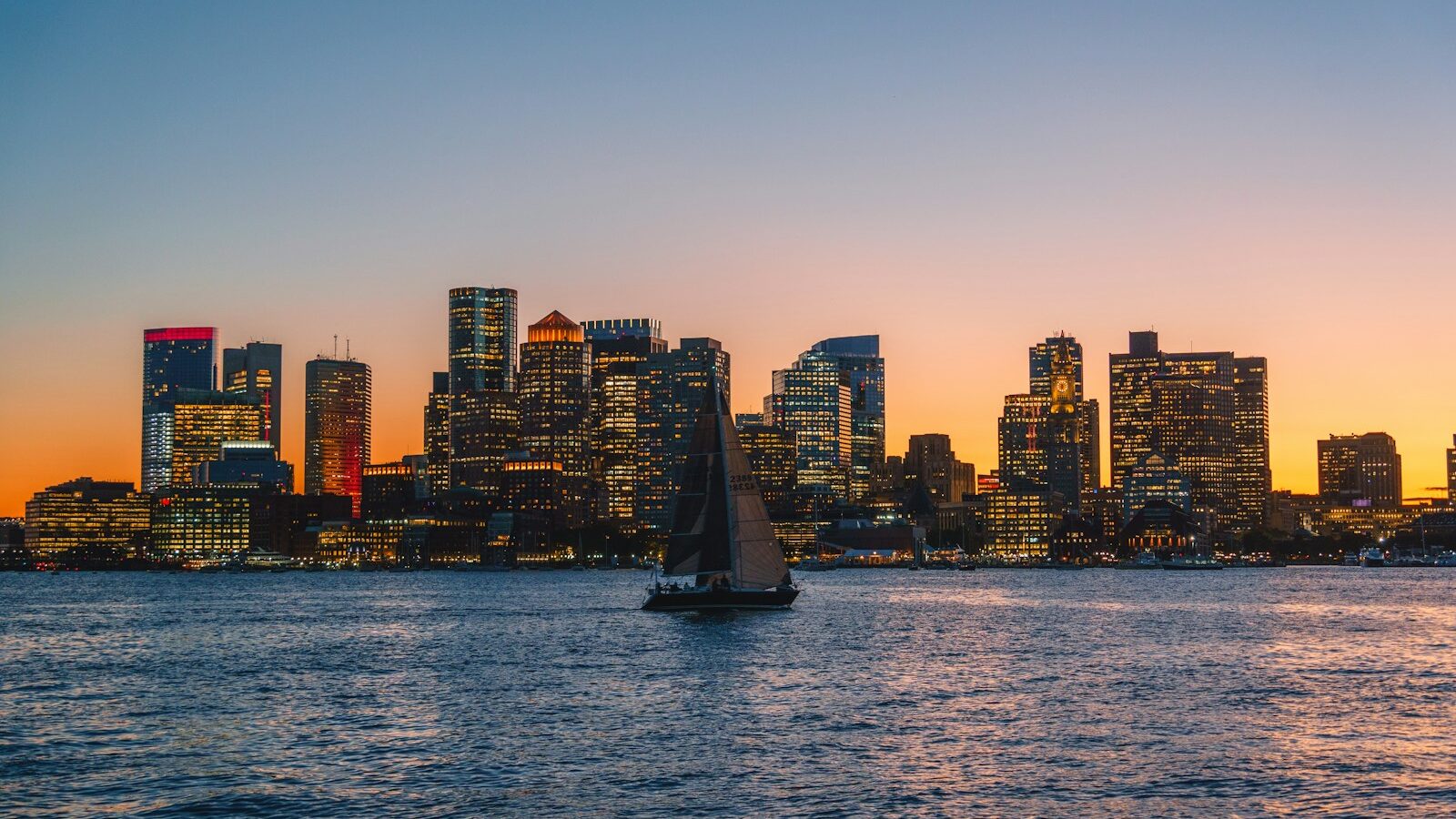
Things to do in Boston start with the Freedom Trail, a red line through the streets that links 16 Revolutionary sites, and go on to world famous art museums, Fenway Park, Harvard and some of the best seafood in the United States. This guide covers the 20 best, with prices checked in November 2026, plus free ideas, winter 2026/27 dates, day trips and a full block for UK and US visitors.
Some links in this guide are affiliate links: if you book through them we may earn a commission at no extra cost to you. It never changes what we recommend. How we make money.
Every entry gives the price in US dollars with a rough pound conversion (at about £1 to $1.32), opening hours where they matter, how long to allow and how to get there on the T, as locals call the subway. One note for UK readers: this is Boston, Massachusetts, not Boston in Lincolnshire.
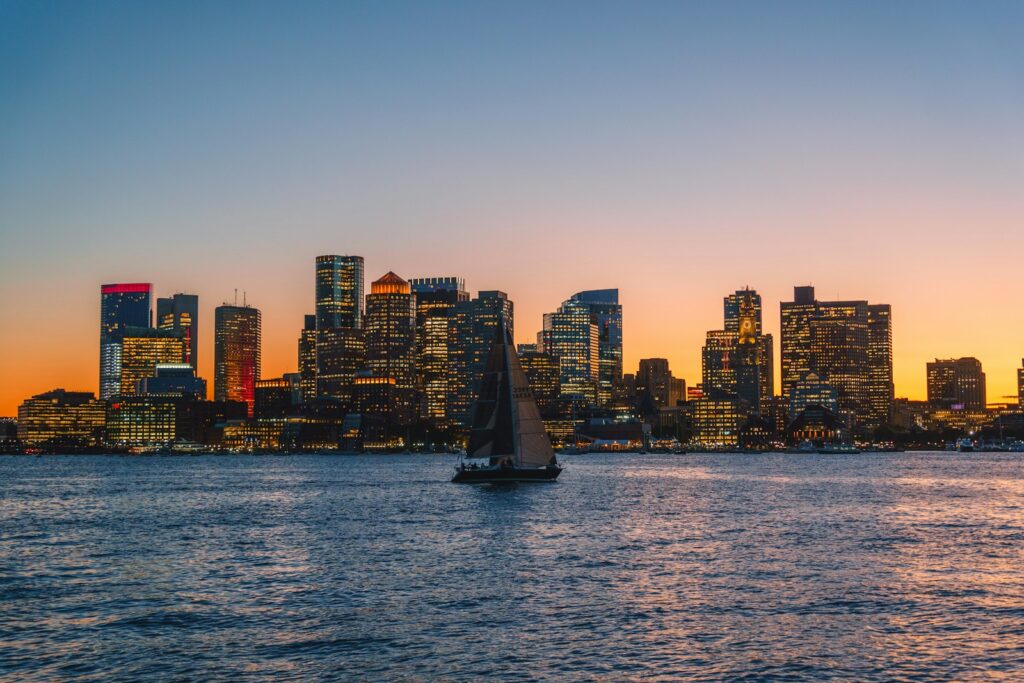
Things to do in Boston at a glance
| Activity | Area | Time needed | Cost (Nov 2026) |
|---|---|---|---|
| Freedom Trail | Boston Common to Charlestown | 3 to 4 hours | Free (guided tour $17, about £13) |
| Boston Common and Public Garden | Downtown | 1 hour | Free |
| Beacon Hill and Acorn Street | Beacon Hill | 1 hour | Free |
| Faneuil Hall and Quincy Market | Downtown | 1 to 2 hours | Free to browse |
| North End and the Paul Revere House | North End | 2 to 3 hours | House $6 (about £4.50) |
| USS Constitution | Charlestown Navy Yard | 1 to 2 hours | Free |
| Boston Tea Party Ships and Museum | Fort Point Channel | 1.5 hours | $35 to $39 (about £27 to £30) |
| Museum of Fine Arts | Fenway | 3 to 4 hours | $30 (about £23) |
| Isabella Stewart Gardner Museum | Fenway | 2 hours | $25 (about £19), free Thursday nights |
| Fenway Park tour | Fenway | 1 hour | $30 (about £23) |
| Harvard and Cambridge | Cambridge | Half a day | Mostly free |
| New England Aquarium | Waterfront | 2 to 3 hours | $39.95 (about £30) |
| View Boston | Back Bay | 1 to 2 hours | From $32 (about £24) plus fee |
| Boston Public Library | Back Bay | 1 hour | Free |
| Museum of Science | Science Park | Half a day | $33 (about £25) |
| JFK Presidential Library | Dorchester | 2 to 3 hours | $20 (about £15) |
| Seaport and the ICA | Seaport | 2 hours | Free on Thursday nights |
| Whale watching | Long Wharf | 3.5 to 4 hours | About $74 to $86, spring to autumn |
| Harbor Islands | Boston Harbor | Half a day | Ferry about $25, May to October |
| Live sport (the “Big 4”) | Fenway, TD Garden | An evening | Varies by game |
How to choose what to do in Boston
Boston is compact, so you can walk between most of the sights on this list. The Freedom Trail, Beacon Hill, the North End and the waterfront sit within a 30 minute walk of each other. The big museums (the MFA and the Gardner) are about 2 miles (3 km) southwest, in the Fenway area, and Harvard is across the Charles River in Cambridge, 15 to 20 minutes away on the Red Line.
- First visit, two or three days: the Freedom Trail, the North End, Beacon Hill, one big museum, Harvard and a seafood dinner.
- Winter trip: museums, Fenway Park tour, the Tea Party ships (indoor and covered), skating, holiday lights and a Celtics or Bruins game.
- With children: the Aquarium, Museum of Science, Boston Children’s Museum and the duckling statues in the Public Garden.
- On a budget: the Freedom Trail on your own, free Thursday nights at the Gardner and the ICA, Harvard Art Museums and the Boston Public Library.
Most things to do in Boston can be reached on the T. A single subway ride costs $2.40 (about £1.80) and you can tap a contactless bank card or phone at the gates.
1. Walk the Boston Freedom Trail
The Freedom Trail is a 2.5 mile (4 km) route marked by a red brick or painted line on the pavement. It links 16 official historic sites, from Boston Common to the Bunker Hill Monument and USS Constitution in Charlestown. You can walk it free on your own, or join a 90 minute guided tour for $17 (about £13).
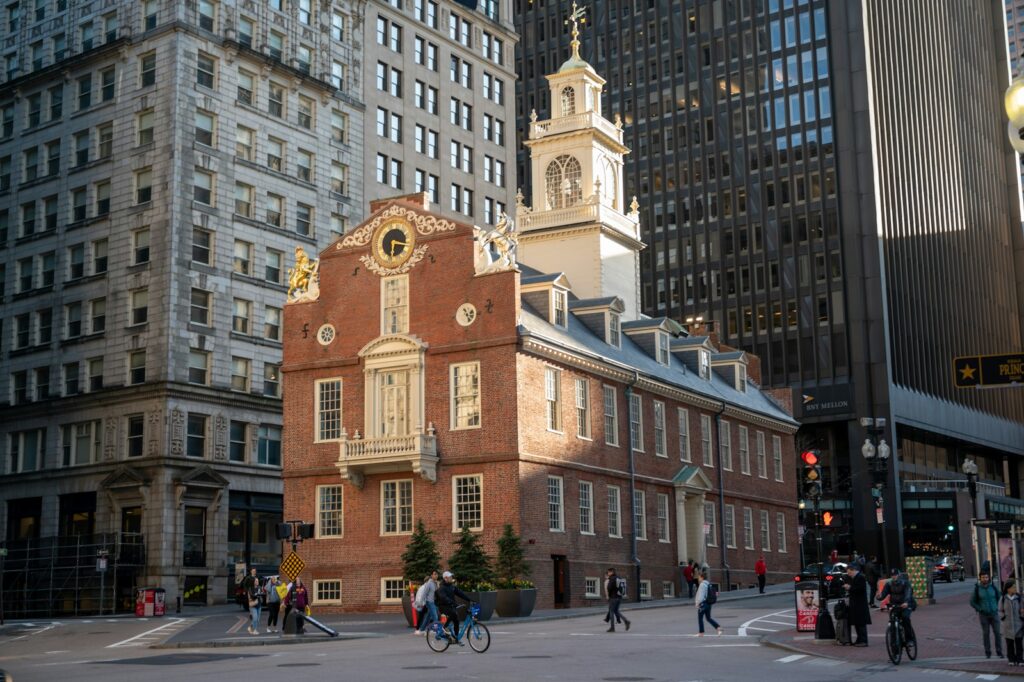
It is the single best introduction to the city and the story of the American Revolution. Along the way you pass the Massachusetts State House with its gold dome, Park Street Church, the Granary Burying Ground (graves of Paul Revere, Samuel Adams and John Hancock), King’s Chapel, the Old South Meeting House, where the Boston Tea Party protest began, the Old State House, the site of the Boston Massacre, and Faneuil Hall.
- Without a tour: start at the Boston Common Visitor Information Center, 139 Tremont Street (Park Street station on the Red and Green Lines) and follow the line. Allow three to four hours with stops, or a full day if you go inside every museum.
- With a tour: the Freedom Trail Foundation’s Walk Into History tour costs $17 for adults, $15 for seniors and students and $8 for children aged 6 to 12 (under 6 free). It lasts 90 minutes, covers 11 of the 16 sites and ends near Faneuil Hall. Guides wear 18th century costume. Book on the Freedom Trail Foundation website.
- Costs inside: most sites are free to see from outside. Paid stops include the Old State House, the Old South Meeting House, the Paul Revere House ($6) and the Old North Church ($10).
2. Boston Common and the Public Garden
Boston Common is the oldest public park in the United States, set aside in 1634, and it is free and open all year. Next door, the Public Garden is a Victorian botanical garden with a lagoon, a suspension bridge and the bronze Make Way for Ducklings statues, which children love to sit on.
In summer the lagoon has the famous Swan Boats (they do not run in winter). In winter the Frog Pond on the Common becomes an outdoor ice rink. For the 2026/27 season, the official site said on 26 November that the rink was not yet open. Admission is $12 (about £9) for skaters 58 inches (147 cm) and taller and free for shorter children; skate hire costs $18 or $12.
The 2026 Boston Common Tree Lighting is on Thursday 3 December 2026 from 6pm to 8pm, next to the visitor centre at 139 Tremont Street. The tree is a gift from Nova Scotia every year, a thank you for Boston’s help after the Halifax Explosion of 1917.
3. Beacon Hill and Acorn Street
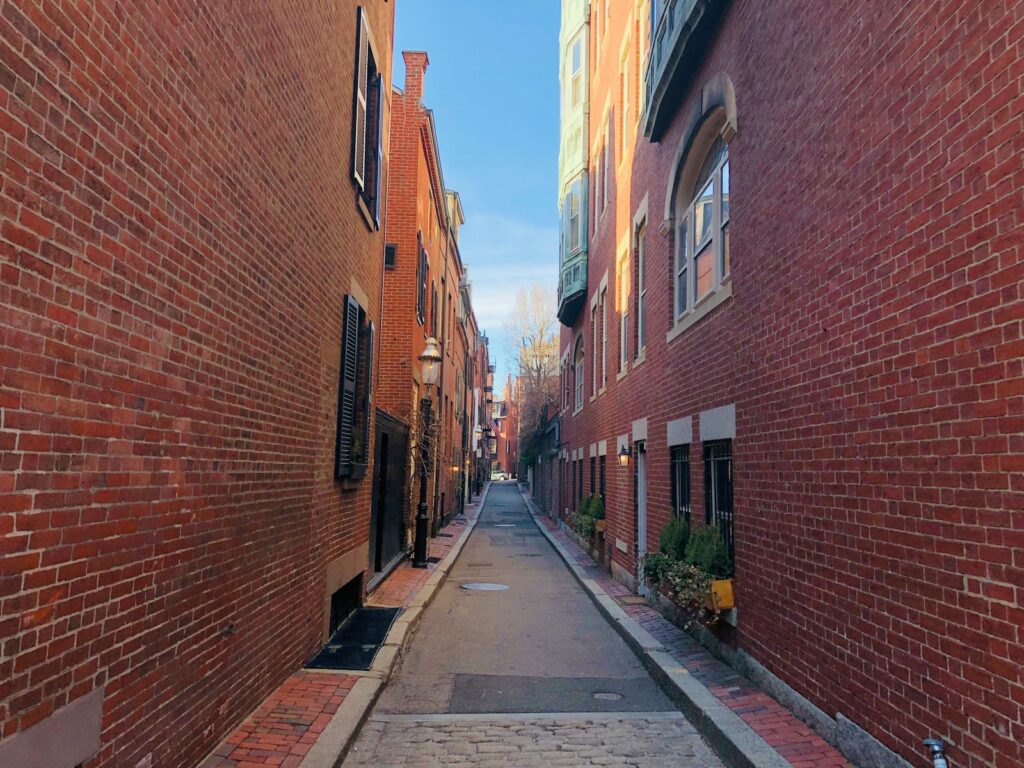
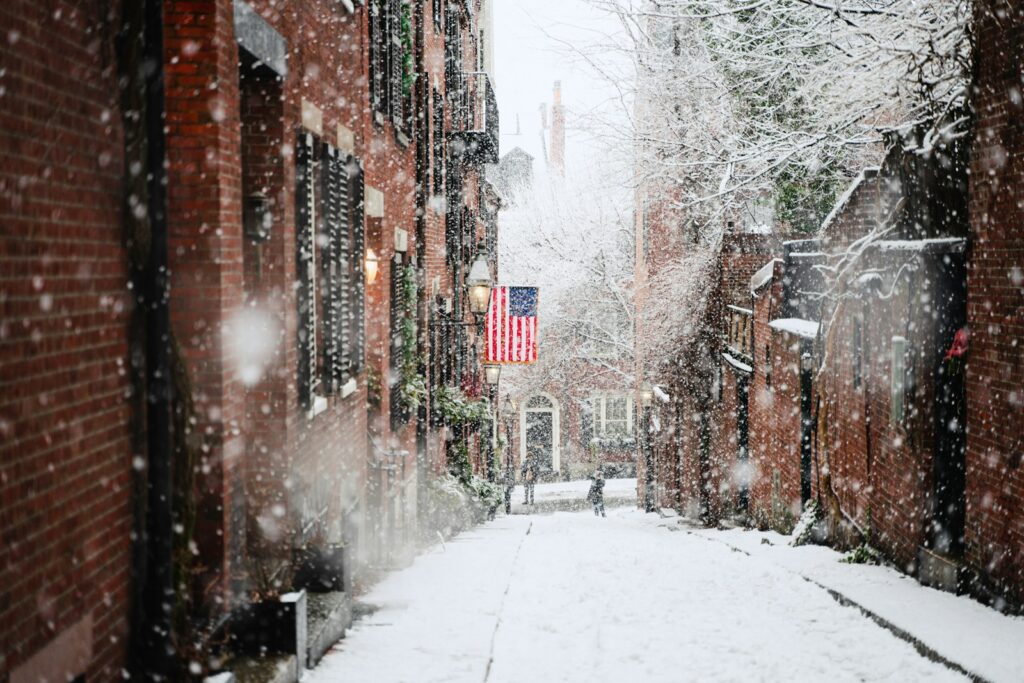
Beacon Hill is the Boston of postcards: brick pavements, gas lamps, black shutters and window boxes. It is free to wander, and an hour is enough to see the best of it. Start on Charles Street, with its antique shops and cafés, then climb to Louisburg Square and Acorn Street, a short cobbled lane that is among the most photographed streets in the country.
Acorn Street is a private way where people live, so keep your voice down and do not block doors. Early morning, or just after a snowfall, is the best time for photos without crowds. Charles/MGH on the Red Line is the nearest station.
4. Faneuil Hall Marketplace and Quincy Market
Faneuil Hall has been a market and meeting hall since 1742 and is known as the “Cradle of Liberty” because colonists made speeches there against British taxes. The upstairs Great Hall is run by the National Park Service and is free. Behind it, Quincy Market is a long hall of food stalls where you can try clam chowder, lobster rolls and Boston cream pie in one place.
It is busy and touristy, but it is the easiest place to eat on the Freedom Trail. Street performers work the cobbled plaza in warmer months. For a quieter sit down meal, the Blackstone Block streets just behind the market have long established seafood restaurants and oyster bars. Take the Green or Orange Line to Haymarket or the Blue Line to Aquarium.
5. The North End, the Paul Revere House and Old North Church
The North End is Boston’s Little Italy and its oldest neighbourhood, a tight grid of narrow streets packed with Italian restaurants, bakeries and cafés. It also holds two of the most important Freedom Trail sites.
- Paul Revere House: the 1680 home of the silversmith who rode to warn the patriots in 1775 is the oldest building in downtown Boston. Admission is $6 for adults (about £4.50), $5.50 for seniors and college students and $1 for children aged 5 to 17. Winter hours (1 November to 14 April) are 10am to 4:15pm; it is closed on Mondays in January, February and March, and on Thanksgiving, 24 and 25 December and 1 January.
- Old North Church: the church where two lanterns were hung in the steeple on 18 April 1775 (“one if by land, two if by sea”). The Discovery Pass costs $10 for adults and $5 for youth and includes the crypt and an audio guide. Add the 25 minute bell chamber tour for $15 in total. It opens Tuesday to Saturday 10am to 5pm and Sunday 12:30pm to 5pm.
Allow two to three hours including lunch. The famous pastry shops on Hanover Street, Mike’s Pastry and Modern Pastry, sell cannoli; queues are long on weekends but move quickly.
6. USS Constitution and the Charlestown Navy Yard
USS Constitution, launched in 1797, is the oldest commissioned warship still afloat in the world, and it is free to board. The ship is crewed by serving US Navy sailors who give short tours. It opens Tuesday to Sunday from 10am to 6pm, but it can close for operations or bad weather.
Visitors aged 18 and over must show a physical photo ID, so overseas visitors should bring their passport; digital IDs are not accepted. The separate USS Constitution Museum on the same pier is a good stop for families. From here, the Bunker Hill Monument is a 15 minute walk uphill. You can climb its 294 steps free of charge; check the National Park Service page for current climbing hours.
To get there, finish the Freedom Trail across the Charlestown Bridge, or take the Charlestown ferry from Long Wharf, which you can pay for with a contactless card.
7. Boston Tea Party Ships and Museum
This is the most fun history museum in Boston and a favourite with families. Actors in costume give you a character from 1773, take you to a town meeting, then let you throw tea crates into the harbour from a replica ship. The visit is a guided experience of about an hour, followed by exhibits and Abigail’s Tea Room.
Tickets cost about $35 to $39 for adults (about £27 to £30), depending on the date, and $26 for children aged 3 to 12, so book online for the best price. Off season tours begin at 10am with the last tour at 4pm. The museum is on the Congress Street Bridge over Fort Point Channel, a 10 minute walk from South Station.
8. Museum of Fine Arts, Boston
The Museum of Fine Arts (MFA) is one of the largest art museums in the United States, with nearly 500,000 objects. Highlights include one of the best collections of Monet paintings outside Paris, John Singer Sargent’s murals, Egyptian treasures, Japanese art and the Art of the Americas wing. General admission is $30 for adults (about £23) and $14 for ages 7 to 17; under 7s are free but still need a ticket.
It opens 10am to 5pm on Saturday to Monday and Wednesday, and until 10pm on Thursday and Friday. It is closed on Tuesdays, and on Thanksgiving, Christmas Day and New Year’s Day; it closes at 5pm on 24 and 31 December. The address is 465 Huntington Avenue; take the Green Line E branch to Museum of Fine Arts station. Allow three to four hours, and use the late Thursday and Friday evenings to avoid crowds.
9. Isabella Stewart Gardner Museum
The Gardner is the most atmospheric museum in Boston: a Venetian style palace built around a flowering courtyard, filled with paintings by Titian, Rembrandt and Sargent exactly as Isabella Stewart Gardner arranged them. Empty frames still hang where 13 works were stolen in 1990, the biggest unsolved art theft in history.
Admission is $25 for adults (about £19), $22 for seniors and $15 for students; under 18s are free, and so is anyone named Isabella. Since July 2026 the museum has been free every Thursday from 5pm to 9pm, with timed tickets released two days before. It is a 5 minute walk from the MFA, so you can combine the two. Closed on Thanksgiving Day, 25 December and 1 January.
10. Tour Fenway Park
Fenway Park opened in 1912 and is the oldest ballpark in Major League Baseball, home of the Boston Red Sox and the 37 foot (11 metre) left field wall known as the Green Monster. The baseball season runs from spring to early autumn, so in winter the 60 minute guided tour is the way to see it.
Public tours cost $30 for adults (about £23) and $21 for children aged 3 to 12. From 1 November to 31 March tours run from 10am to 5pm; in season they leave on the hour from 9am. Take the Green Line to Kenmore. If you are in Boston from April to September, a game is even better: the bleachers are the cheapest seats.
11. Harvard University and Cambridge
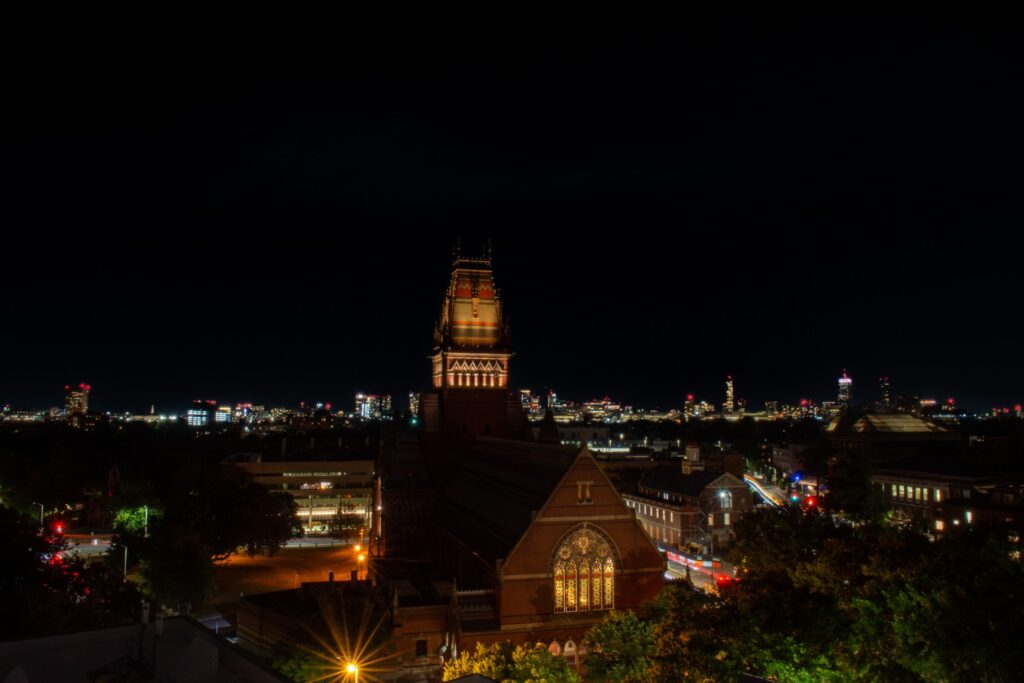
Harvard Yard, the heart of the oldest university in the United States (founded 1636), is free to walk through. Rub the shoe of the John Harvard statue, look into Widener Library from the steps, and walk on to Memorial Hall. Harvard Square has bookshops, cafés and street music.
- Harvard Art Museums: free for everyone since 2023. Three museums in one Renzo Piano building, with strong collections of German Expressionist and Impressionist art.
- Harvard Museum of Natural History and Peabody Museum: one ticket covers both, $20 for adults (about £15) and $15 for ages 3 to 18. The famous Glass Flowers gallery is worth the trip alone. Open daily 9am to 5pm; closed 24 to 28 December and 1 January 2027.
- MIT: a stop further along the Red Line at Kendall/MIT, the campus is free to explore, with public art and the MIT Museum.
Take the Red Line to Harvard station (about 15 minutes from Park Street). Allow half a day for Harvard and the Square.
12. New England Aquarium
The New England Aquarium on Central Wharf is built around a four storey Giant Ocean Tank with sea turtles, sharks and a coral reef, plus penguins, harbour seals and a large touch tank. It is one of the best things to do in Boston with kids, especially on a cold or wet day.
Admission is $39.95 for adults (about £30), $30.95 for children aged 3 to 11 and $37.95 for seniors; under 3s are free. A combined ticket with a film in the Simons Theatre costs $44.95. It opens 9am to 5pm on weekdays and 9am to 6pm at weekends. Weekends often sell out, so buy online. Aquarium station on the Blue Line is right outside.
13. View Boston at the Prudential Center
View Boston is the city’s observation deck, at the top of the Prudential Tower in Back Bay, with indoor and outdoor decks, interactive exhibits and a rooftop bar called Stratus. On a clear day you can see the harbour islands, Fenway Park and across to Cambridge.
Tickets start at $32 (about £24) plus a $3 booking fee. It opens daily from 10am to 10pm, with last entry at 9:15pm; it is closed on Thanksgiving Day. Go just before sunset to see the city in daylight and lit up at night. The entrance is inside the Prudential Center shopping mall, near center court; Prudential station on the Green Line E branch is closest.
14. Boston Public Library
The central Boston Public Library on Copley Square is free and well worth an hour. The 1895 McKim Building has a marble staircase, John Singer Sargent murals and Bates Reading Room, a vast barrel vaulted hall with green lamps. There is a peaceful Italian style courtyard with a café.
Across the square, Trinity Church is a masterpiece of 19th century American architecture, and Newbury Street, the city’s best shopping street, starts two blocks away. Copley station on the Green Line is right outside.
15. Museum of Science
The Museum of Science sits on a dam over the Charles River and has hundreds of hands on exhibits, a lightning show in the Theater of Electricity, a planetarium and a giant dome cinema. Exhibit halls cost $33 for adults (about £25), $28 for children aged 3 to 11 and $29 for seniors; the planetarium and cinema cost extra.
It opens daily from 9am to 5pm, with planetarium and cinema shows until 10pm on Friday and Saturday. It is closed on Thanksgiving and Christmas Day and closes at 2pm on the day before Thanksgiving and on Christmas Eve. Science Park/West End on the Green Line is the closest stop.
16. John F. Kennedy Presidential Library and Museum
The JFK Library, in a striking I. M. Pei building on Columbia Point, tells the story of Kennedy’s life and presidency through film, his Oval Office desk and the Cuban Missile Crisis galleries. The glass pavilion looks over Dorchester Bay to the skyline.
It opens daily from 9am to 5pm (closed on Thanksgiving, Christmas Day and New Year’s Day). Adult tickets are $20 (about £15), seniors and college students pay $12, teens aged 13 to 17 pay $10 and children 12 and under are free. Take the Red Line to JFK/UMass, then walk about 20 minutes or use the museum shuttle where it runs. Allow two to three hours.
17. Seaport, the ICA and the Harborwalk
The Seaport is Boston’s newest district, full of restaurants, rooftop bars and offices built over old wharves. The Institute of Contemporary Art (ICA) cantilevers out over the water and is free every Thursday from 5pm to 9pm; timed tickets are released at 10am that morning.
The Harborwalk is a public path along the waterfront, and a walk from the Seaport past Fort Point to Long Wharf takes about 30 minutes. For something local, head on to Castle Island in South Boston, where a path loops around Fort Independence, an old granite fort, with planes from Logan flying low overhead. The Silver Line SL1 and SL2 buses serve the Seaport.
18. Whale watching from Long Wharf
Boston is one of the best cities in the world for whale watching, because the Stellwagen Bank National Marine Sanctuary, a feeding ground for humpback, fin and minke whales, is about 25 miles (40 km) offshore. Trips run by Boston Harbor City Cruises in partnership with the New England Aquarium leave from Long Wharf and last three and a half to four hours.
The season runs from late March or spring through autumn, with peak sightings from May to October, so it is not an option in December to February. Adult tickets cost about $74 to $86 (about £56 to £65), depending on the date. Take warm layers even in summer, and seasickness tablets if you need them.
19. Boston Harbor Islands
The Boston Harbor Islands are a national and state park of 34 islands, reached by ferry from Long Wharf in about 30 to 45 minutes. Georges Island has Fort Warren, a Civil War era fort with tunnels to explore; Spectacle Island has a beach, a hill with skyline views and walking trails.
The 2026 ferry season ran from 15 May to 12 October, so this is a late spring to early autumn day out; the 2027 schedule is usually published in spring. The last published adult fare was $24.95 (about £19) return, with children at $17.95. Pack a picnic, as food options on the islands are limited.
20. See a game: the “Big 4” Boston teams
Boston sport is a big part of the city’s identity. The “Big 4” are the Red Sox (baseball, Fenway Park, April to September), the Celtics (basketball) and Bruins (ice hockey), who both play at TD Garden above North Station from October to April, and the Patriots (American football), who play at Gillette Stadium in Foxborough, about 25 miles (40 km) south.
In winter, a Celtics or Bruins game is one of the best things to do in Boston at night. Buy from the team’s official site or the official resale platforms, and expect prices to vary widely by opponent. Bars near North Station and around Fenway fill up before games and are fun even without a ticket.
Free things to do in Boston
Boston is better value than it first looks, because many of its best sights cost nothing. These are the best free things to do in Boston, all checked in November 2026:
- Freedom Trail: walk the red line on your own, past 16 historic sites.
- Boston Common and the Public Garden: including the Make Way for Ducklings statues.
- Beacon Hill and Acorn Street: the city’s most beautiful streets.
- Faneuil Hall Great Hall: run by the National Park Service.
- USS Constitution and the Bunker Hill Monument: both free, ID needed for the ship.
- Boston Public Library: murals, Bates Hall and the courtyard.
- Harvard Yard and the Harvard Art Museums: free for everyone.
- Gardner Museum on Thursday nights: 5pm to 9pm, book two days ahead.
- ICA on Thursday nights: 5pm to 9pm, tickets released that morning.
- The Harborwalk and Castle Island: waterfront walks with skyline views.
- Arnold Arboretum: 281 acres of trees and gardens in Jamaica Plain, run by Harvard.
- Free rides from the airport: the Silver Line SL1 bus from Logan Airport to South Station is always free.
Things to do in Boston in winter
Boston winters are cold, with January highs averaging 36°F (2°C) and lows of 22°F (minus 6°C). Snow usually falls between December and March. That makes a winter trip cheaper and less crowded, and the city looks beautiful under snow. These are the best things to do in Boston in winter 2026/27:
- Boston Common Tree Lighting: Thursday 3 December 2026, 6pm to 8pm, free.
- Boston Winter at City Hall Plaza: an outdoor skating path and holiday market. The skating path opens 11am to 9pm Monday to Thursday, 11am to 11pm Friday, 10am to 11pm Saturday and 10am to 9pm Sunday; it closes on Christmas Day. Check the City of Boston site for this season’s dates.
- Frog Pond skating: on Boston Common, $12 for adults, free for children under 58 inches; opening date for 2026/27 not announced on 26 November.
- First Night Boston: the city’s free New Year’s Eve celebration on 31 December, with ice sculptures and performances across the city; check the official programme nearer the date.
- Indoor days: the MFA (open until 10pm on Thursday and Friday), the Gardner, the Aquarium, the Museum of Science and the JFK Library.
- Sport: Celtics and Bruins games at TD Garden.
Most attractions keep normal hours in winter, but almost all close on Thanksgiving (Thursday 26 November 2026) and Christmas Day, and many close on 1 January. Heavy snowstorms (locals call them nor’easters) can shut sights for a day, so keep a flexible plan.
Things to do in Boston this weekend: a two day plan
If you only have a weekend, this is the plan we would follow.
- Saturday morning: walk the Freedom Trail from Boston Common to Faneuil Hall, with a coffee on the way.
- Saturday lunch: Quincy Market or a sit down lunch in the North End.
- Saturday afternoon: the Paul Revere House and Old North Church, then over the bridge to USS Constitution.
- Saturday evening: dinner in the North End, or a Celtics or Bruins game in winter.
- Sunday morning: Beacon Hill and Acorn Street early, then the Public Garden.
- Sunday afternoon: the Museum of Fine Arts or the Gardner, or Harvard if you prefer.
- Sunday evening: sunset at View Boston, then dinner in Back Bay.
With a third day, add Harvard and Cambridge, the Tea Party Ships and the Seaport, or a day trip to Salem.
Things to do in Boston with kids
Boston is easy with children: distances are short and many sights are built for them.
- Boston Children’s Museum: on Fort Point Channel next to the Tea Party Ships. Adults and children aged 1 to 15 pay $24 (about £18); babies under 12 months are free. Open Wednesday to Monday from 9am to 4pm, closed on Tuesdays.
- New England Aquarium: penguins, seals and the giant tank.
- Museum of Science: hands on exhibits and the lightning show.
- Boston Tea Party Ships: throwing tea into the harbour is a guaranteed hit.
- Make Way for Ducklings: the statues in the Public Garden, based on the classic picture book.
- Harvard Museum of Natural History: dinosaur fossils and animals.
- Frog Pond: free skating for children under 58 inches, with skate hire for $12.
A Boston CityPASS ($84 for adults, $72 for ages 3 to 11) gives entry to four of seven attractions (the Aquarium, Museum of Science, MFA, View Boston, a harbour cruise, Franklin Park Zoo and the Harvard Museum of Natural History) over nine days. It only saves money if you would visit four of them anyway.
Day trips from Boston
Boston is a good base for New England. These are the best day trips from Boston, with rough travel times:
- Salem: about 30 minutes on the Commuter Rail from North Station. Famous for the 1692 witch trials, the Peabody Essex Museum and a historic waterfront. It gets very crowded in October.
- Lexington and Concord: about 40 minutes by car. Walk Minute Man National Historical Park, where the first battles of the Revolution were fought, and visit Louisa May Alcott’s Orchard House in Concord.
- Plymouth: about an hour south by car or Commuter Rail, for Plymouth Rock and the Mayflower story.
- Cape Cod: about one and a half to two hours by car to the beaches and villages; best from late spring to early autumn.
- Newport, Rhode Island: about one and a half hours by car, for the Gilded Age mansions and the Cliff Walk.
- Portland, Maine: about two and a half hours on the Amtrak Downeaster from North Station, for lobster and lighthouses.
For Commuter Rail trips, a weekend pass costs $10 (about £8) for unlimited travel on Saturday and Sunday on all lines. Buy it in the MBTA mTicket app.
Getting around Boston
Boston’s subway, buses and ferries are run by the MBTA. Check fares and routes on the MBTA website.
- Fares: $2.40 (about £1.80) per subway ride and $1.70 per local bus ride. You can tap a contactless bank card or phone, or use a CharlieCard.
- Passes: a 1 Day Pass costs $11 (about £8) and a 7 Day Pass $22.50 (about £17). Passes are loaded on a CharlieCard or CharlieTicket, not on your bank card.
- From Logan Airport: the Silver Line SL1 bus to South Station is always free from the airport. The Blue Line from Airport station reaches downtown in about 10 minutes. Taxis and rideshares are quick outside rush hour, but the tunnels jam at peak times.
- Walking: the best way to see central Boston. Wear waterproof shoes in winter.
- Driving: not worth it in the city. Streets are confusing, parking is expensive and the T reaches every sight on this list.
What to skip
- Driving into the city: hire a car only for day trips.
- The Cheers bar in Beacon Hill: fun for fans, but the inside is not the TV set, so a photo outside is enough.
- Long queues at Mike’s Pastry: Modern Pastry and other Hanover Street bakeries are just as good.
- Harbor cruises and whale watching in December to February: most do not run, and those that do are cold.
- Rushing the whole Freedom Trail and every museum in one day: split it and you will enjoy it more.
How much things to do in Boston cost
Boston is one of the more expensive cities in the United States, mainly because of hotel prices. Prices below were checked in November 2026; pounds are approximate at £1 to $1.32.
| Item | Price (USD) | About (GBP) |
|---|---|---|
| Freedom Trail on your own | Free | Free |
| Freedom Trail guided tour | $17 | £13 |
| Museum of Fine Arts | $30 | £23 |
| Gardner Museum | $25 (free Thu 5pm to 9pm) | £19 |
| Boston Tea Party Ships | $35 to $39 | £27 to £30 |
| New England Aquarium | $39.95 | £30 |
| Fenway Park tour | $30 | £23 |
| View Boston | From $32 plus $3 fee | From £26 |
| JFK Library | $20 | £15 |
| Boston CityPASS | $84 | £64 |
| Subway ride / 7 Day Pass | $2.40 / $22.50 | £1.80 / £17 |
| Clam chowder or lobster roll lunch | Varies, plan on $20 to $40 | £15 to £30 |
| Central hotel, one night | Often $250+ in winter, more in autumn | £190+ |
Shop and menu prices usually exclude tax. Massachusetts sales tax is 6.25% and meals in Boston are taxed at 7%, and hotels add room taxes of close to 15% in the city.
Practical tips for UK and US visitors
Entry rules
British citizens visiting the United States for up to 90 days need an approved ESTA before they travel. The fee has been $40.62 (about £31) per person since 16 October 2026. Apply only on the official ESTA website or the official ESTA Mobile app, at least 72 hours before you fly. Our step by step ESTA application guide explains how to avoid unofficial sites that charge extra.
US citizens need no travel documents beyond a REAL ID compliant licence or a passport for domestic flights. Irish citizens follow the same ESTA rules as British citizens. Rules change, so check the UK government’s travel advice for the USA before booking.
Flights to Boston
Boston Logan International Airport (BOS) is just 3 miles (5 km) from downtown, one of the closest big city airports in the country.
- From London: nonstop from Heathrow with British Airways, Virgin Atlantic, Delta, American Airlines and JetBlue, all year. JetBlue also flies from Gatwick in season. Flights take about seven to seven and a half hours westbound and around six and a half hours back.
- From Manchester: there is no year round nonstop flight. The simplest option is Aer Lingus via Dublin, where you clear US immigration before you board and land in Boston as a domestic passenger, or a connection via London or New York.
- From Ireland: Aer Lingus and Delta fly nonstop from Dublin all year, and Aer Lingus from Shannon, with US preclearance at both airports.
- From Edinburgh: seasonal nonstop flights with Delta and JetBlue, mainly in summer.
- From the US: about 1 hour 15 minutes from New York, 1 hour 30 minutes from Washington, 2 hours 30 minutes from Chicago and around 6 hours from Los Angeles. Amtrak trains from New York Penn Station take around three and a half to four and a half hours.
Time, money and plugs
- Time difference: Boston is five hours behind London and on the same time as New York. Between 14 and 28 March 2027 the gap is four hours, because US clocks change two weeks before UK clocks.
- Currency: US dollars. Cards and contactless payments are accepted almost everywhere; use a card without foreign transaction fees.
- Tipping: much higher than in the UK. Tip 18% to 20% in restaurants with table service, $1 to $2 per drink at a bar, and 15% to 20% for taxis and tour guides. Check the bill first, as some restaurants add a service charge.
- Plugs: Type A and B sockets at 120 volts. UK visitors need an adapter; most phone and laptop chargers work, but check hair dryers and straighteners.
- Driving: on the right. A UK licence is accepted for visitors renting a car, though some rental firms ask for an International Driving Permit too.
- Weather: January highs average 36°F (2°C); July highs reach 83°F (28°C). December and March are usually the wettest months.
- Mobile data: an eSIM is usually cheaper than roaming for UK visitors.
Our picks: a Boston bucket list
- Best overall: the Freedom Trail, ending at USS Constitution.
- Best museum: the Isabella Stewart Gardner Museum, ideally on a free Thursday night.
- Best for art lovers: the Museum of Fine Arts.
- Best for families: the Boston Tea Party Ships and the New England Aquarium.
- Best free view: the Harborwalk at sunset, or the skyline from Castle Island.
- Best food experience: chowder in Quincy Market, then cannoli in the North End.
- Best winter night: a Celtics or Bruins game, then a drink near North Station.
- Best day trip: Salem, on the train from North Station.
Frequently asked questions
What are the top three things to do in Boston?
The top three things to do in Boston are walking the Freedom Trail, exploring the North End and Beacon Hill, and visiting either the Museum of Fine Arts or the Isabella Stewart Gardner Museum. Together they show the city’s history, its neighbourhoods and its world class art in two days.
What should you not miss in Boston?
Do not miss the Freedom Trail, Beacon Hill’s Acorn Street, a cannoli in the North End, USS Constitution and Harvard Yard. In season, a Red Sox game at Fenway Park or a whale watch is the highlight for many visitors; in winter, swap these for a Fenway tour and a Celtics or Bruins game.
What are the big 4 in Boston?
The “Big 4” are Boston’s four major professional sports teams: the Red Sox (baseball), the Celtics (basketball), the Bruins (ice hockey) and the Patriots (American football). The Celtics and Bruins share TD Garden, the Red Sox play at Fenway Park and the Patriots play at Gillette Stadium in Foxborough.
Is Boston expensive to visit?
Yes, Boston is one of the more expensive US cities, mainly because hotels often cost $250 or more a night, and taxes and tips add around 25% to restaurant bills. You can save with free sights like the Freedom Trail, free Thursday nights at museums, the free airport bus and a $22.50 weekly T pass.
What to do in Boston for a weekend?
For a weekend in Boston, spend Saturday on the Freedom Trail, the North End and USS Constitution, then Sunday in Beacon Hill, the Public Garden and the Museum of Fine Arts or the Gardner, ending with sunset at View Boston. See our two day plan above for the full timings.
Is 3 days in Boston enough?
Three days is enough to see the main sights of Boston. Use day one for the Freedom Trail and the North End, day two for Beacon Hill, the Public Garden and a big museum, and day three for Harvard and Cambridge or the Seaport. Add a fourth day for a day trip to Salem or Concord.
What is the best month to go to Boston?
September and October are the best months to visit Boston, with mild weather, autumn colours and baseball still on. May and June are also pleasant. Winter (December to February) is cold but cheaper, with holiday events, skating and sport, while July and August are warm, busy and humid.
What is the rainiest month in Boston?
December and March are usually the wettest months in Boston, while February and August are among the driest. Rain is spread fairly evenly across the year, though, so pack a waterproof jacket whenever you go, and expect snow rather than rain on many winter days from December to March.
Where to avoid staying in Boston?
Avoid booking a cheap hotel far from a T station, as you will lose time and money on taxis. Most visitors are happiest in Back Bay, Beacon Hill, Downtown, the Waterfront or the Seaport. The area around Massachusetts Avenue and Melnea Cass Boulevard, known locally as “Mass and Cass”, has long had visible drug use problems and is best avoided at night.
Is $75,000 a good salary in Boston?
It is enough for a single person but tight for a family. MIT’s Living Wage Calculator (data updated February 2026) puts the living wage for one adult with no children in Suffolk County, which includes Boston, at $69,891 a year before tax, and $88,018 for a couple with one earner. Housing is the biggest cost.
Plan the rest of your trip
Boston pairs well with other East Coast and North American cities. Many visitors combine it with New York by train; see our guide to things to do in New York for the observation decks, Broadway and Christmas in the city. For another great architecture city, read our guide to things to do in Chicago, and for a cross border add on, our guide to things to do in Toronto.
Before you book, read our ESTA application guide, and browse more ideas in our Boston travel guides. For official event listings, see Meet Boston, the city’s tourism board.
Whatever the season, the best things to do in Boston are close together, so you will see more on foot than you expect. Start on the Freedom Trail and let the red line lead you through the city.